Windows are the most underused Christmas canvas in a small rented flat. They face the street, so a decorated window spreads festive cheer to everyone walking past, and from inside they frame the season every time you look up from the sofa. Best of all, glass is the easiest surface in a rental to decorate without damage: nothing needs a nail, a screw or a drill, and almost everything on this list peels, unhooks or lifts off in January leaving the window exactly as you found it.
That is the promise behind every idea below. Each one is no-drill, no-nails and no-mark, built around the four fixings every renter should keep in a drawer: Command hooks and strips, suction hooks, static-cling decals, and tension rods. Each one is also priced for a small budget — most come in under $15, and several cost nothing at all if you already have paper, scissors and a spare string of lights. Pick two or three ideas rather than all ten and your windows will look deliberately dressed, not cluttered, which matters when the window is also your main source of daylight. And if you are planning the rest of the room, our renter-friendly Christmas tree alternatives under $25 pair beautifully with a decorated window, and our Christmas window candles under $25 show how a single glowing candle finishes the look.
A quick word on glass before you start: clean the pane first. Suction hooks, static cling and spray frost all grip far better on clean glass than on a dusty pane, and a quick wipe with glass cleaner takes thirty seconds per window. Test every fixing in November rather than on the day you decorate, and always check the weight rating on a Command strip or suction hook before you hang anything heavy from it. With that done, here are ten ideas that leave no marks.
1. Fairy lights around the window frame on Command hooks
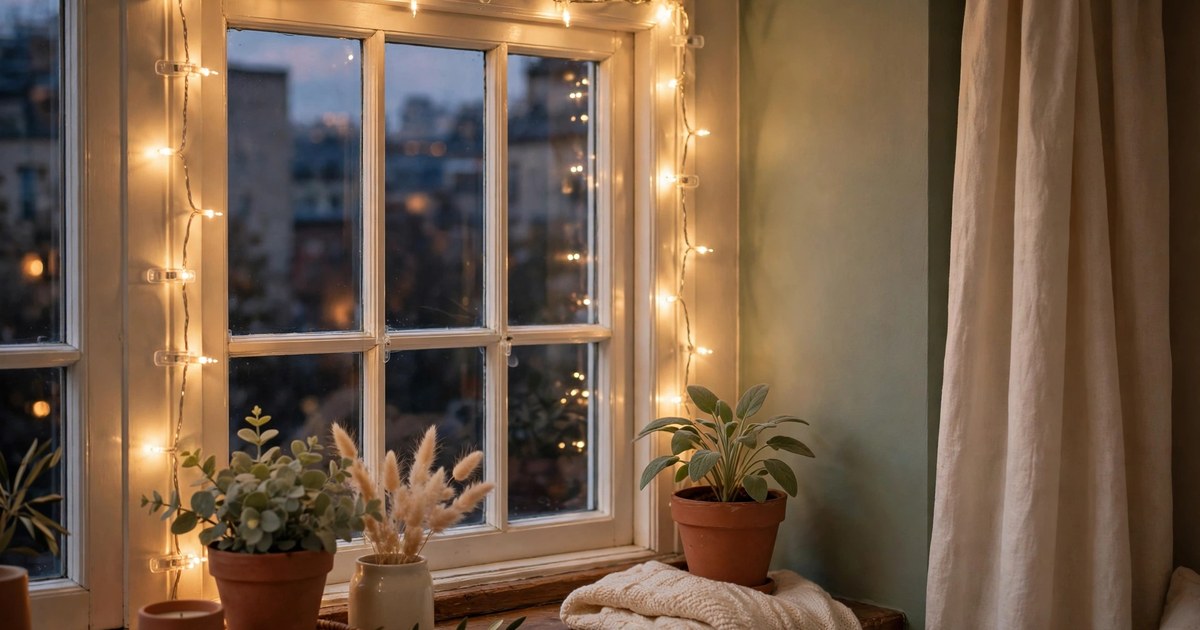
Fairy lights are the single highest-impact window decoration a renter can buy, and the whole trick is in how you hang them. Small clear Command hooks — the mini ones rated for half a pound — stick to the painted frame or the wall around the window, hold a light string perfectly, and peel off in January with the pull tab, leaving no mark on the paint. Run one string around the inside of the frame, spacing the hooks every 30 centimetres or so, and let the lights sit just inside the glass so they glow from the street and wash the room in warm light at the same time.
Choose warm white over cool white for a small flat: warm white flatters terracotta, cream and wood tones and reads as candlelight from outside, while cool white can make a small room feel like a shop window. Battery-powered strings are the renter's friend here because they need no socket near the window and no cable trailing across the floor — a 3-metre string of 40 LEDs costs around $6–10, and a set with a built-in timer switches itself on at dusk and off six hours later. If your window has a deep reveal, drape a second string in a gentle swag across the top instead of a straight run; the dip in the middle catches the eye and makes the whole window look dressed rather than outlined.
Keep the cable tidy by tucking the battery pack behind the curtain or on the sill behind a plant, and use the same Command hooks year after year — the hooks themselves are reusable if you buy fresh adhesive strips each season. When January comes, pull the tabs slowly and straight down, exactly as the packet shows, and the paint stays untouched. That is the whole secret: the right hook, the right removal, and a string of lights that costs less than a takeaway.
2. Static-cling snowflake decals
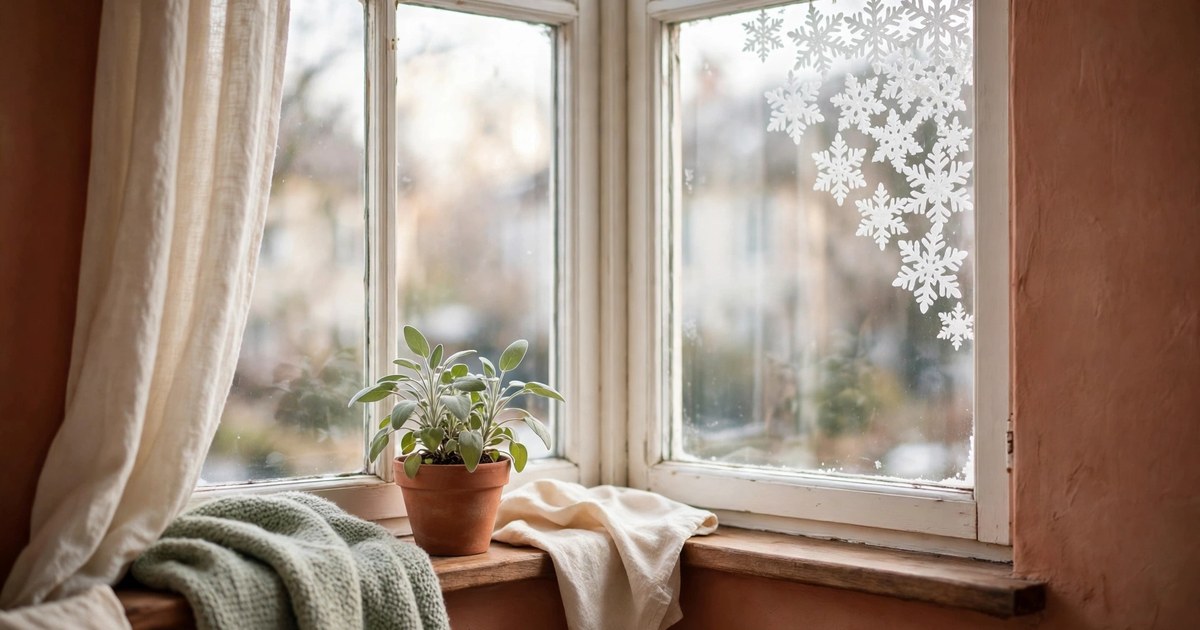
Static-cling decals are the closest thing to magic in renter-friendly decorating. They are thin vinyl shapes — snowflakes, stars, reindeer, whole winter scenes — that stick to glass with static alone, no glue and no adhesive at all. Press one onto a clean window and it stays put all December; peel it off in January and there is nothing to clean, nothing to scrape, and nothing for a landlord to spot. A sheet of snowflakes costs around $4–8, and one sheet usually covers a whole window.
The trick to making decals look expensive rather than like a child's sticker sheet is placement. Cluster the snowflakes in one corner of the pane, denser at the edge and sparser toward the middle, so they look like snow drifting against the glass rather than a grid. Mix two sizes if the pack allows it, and leave the centre of the window clear so daylight still comes through and you can still see out. On a double window, mirror the cluster on both panes for a balanced look from the street. Decals also layer beautifully with fairy lights: lights behind the decals make the vinyl glow softly at night, and the combination reads as a proper window display rather than two separate decorations.
Store the decals flat on their backing sheet when the season ends and they will work again next year — static cling survives several seasons if the vinyl stays clean and flat. If a decal loses its grip, a wipe with a damp cloth restores the static. That reusability makes them the cheapest decoration on this list per year of use, and the most forgiving: if you do not like the arrangement, peel it off and try again, as many times as you like, with zero consequences.
3. Paper snowflakes on the glass
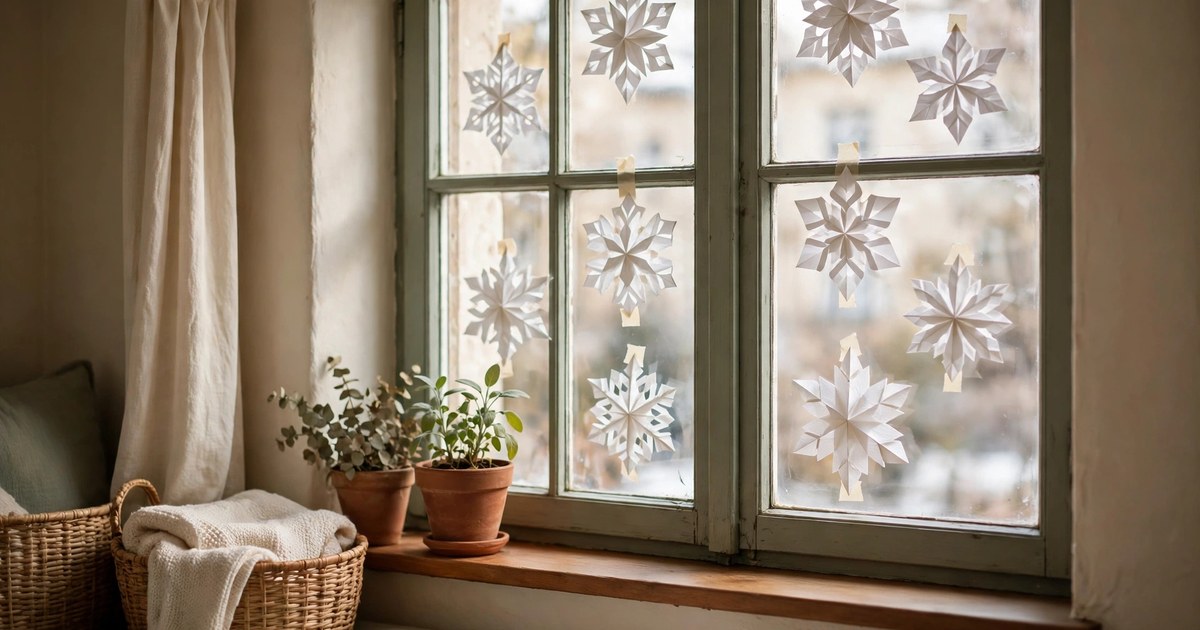
Paper snowflakes cost nothing, take an evening to make, and are the most charming window decoration on this list precisely because they are handmade. All you need is white paper — plain printer paper works, tissue paper looks softer — scissors, and a roll of washi tape or a few dots of removable poster putty. Fold, cut, unfold, and you have a snowflake; make ten or twelve in different sizes and you have a whole window display for the price of a sheet of paper.
Stick them to the inside of the glass with small loops of washi tape or poster putty, both of which peel off cleanly and leave no residue on glass. Vary the sizes and scatter them across the pane rather than lining them up in rows, and mix in a few folded stars or simple paper trees for variety. If you have children, this is the idea to make together — every snowflake comes out different, and the wonky ones are the ones you will love most. For a more polished look, cut them from white or cream card and hang the largest ones from the top of the frame on thread, so they dangle and turn gently in the draught.
The beauty of paper snowflakes is that they solve the renter's biggest fear — damage — completely, because there is nothing to damage. No adhesive touches the frame, the tape touches only glass, and the whole display comes down in two minutes with a bin bag. Keep your favourites flat in a book or an envelope and they will be ready to tape up again next December, which makes this the only decoration on this list that is genuinely free.
4. Garland across the top on a tension rod

A garland across the top of a window is the classic Christmas look, and a tension rod makes it renter-proof. A tension rod is a spring-loaded bar that wedges between the two sides of a window reveal — no screws, no brackets, no holes — and it holds a surprising amount of weight. Slide a lightweight faux garland over the rod, or drape it across the rod and let it swag gently in the middle, and you have a dressed window in five minutes. A basic tension rod costs around $5–8, and a plain green garland starts at about $8–12.
Keep the garland light. A slim faux-pine garland, or one made from eucalyptus stems, is ideal; a heavy garland loaded with baubles will pull a tension rod down, so save the heavy decorations for the sill. Once the garland is up, weave a string of fairy lights through it for evening glow, and tuck in a few pine cones or dried orange slices for texture — all of which weigh almost nothing. The garland also does a useful job in a small flat: it softens the hard top edge of the window and draws the eye upward, which makes a low-ceilinged room feel taller.
Measure your window reveal before you buy the rod, because tension rods come in size ranges and you need one that fits your width with the spring compressed. Twist to extend, wedge it firmly in place, and test it with a gentle tug before you hang the garland. In January the rod comes down with a twist, the garland folds into a bag, and the window reveal is exactly as it was — no holes, no marks, no evidence at all.
5. Battery window candles on the sill
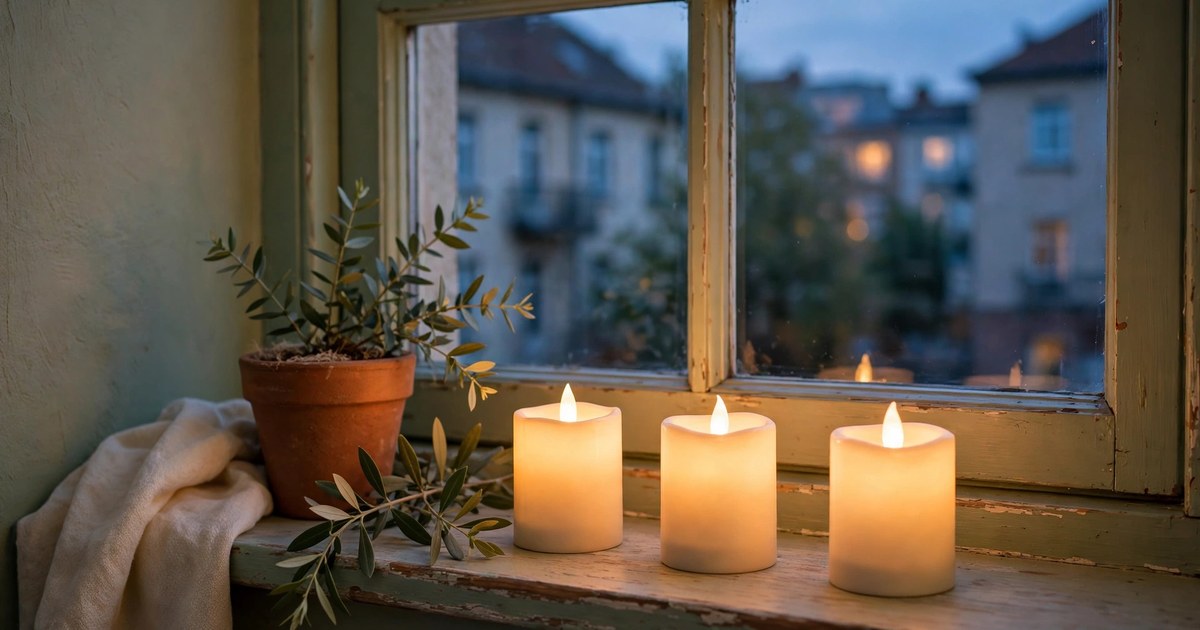
A row of battery candles on the sill is the warmest, simplest window decoration there is, and it needs no fixing at all — the candles simply stand on the sill. Flameless LED candles give you the glow of a real flame with none of the risk: no wax on a painted sill, no open flame near curtains, and no argument with a landlord about fire safety. A pair with a built-in timer costs around $9–15, and the timer is the feature that matters most — switch them on once at 5pm and they light themselves at the same time every evening.
Place one candle in each window for a uniform look from the street, or cluster two or three on the main living-room sill with a small sprig of greenery laid in front of them. Warm-white LEDs are the right colour here; they read as candlelight from the pavement and throw a soft amber wash across the room after dark. If your sill is narrow, choose slim taper candles rather than chunky pillars, and check the base is stable before you walk away — a candle that topples onto a radiator cover is the only real risk, and a wide base solves it.
Window candles pair naturally with almost everything else on this list: fairy lights around the frame, a garland above, decals on the glass. Because they stand on the sill rather than sticking to anything, they are also the easiest decoration to move — shift them to the bedroom window for a party, bring them back for a quiet evening, and take them down in January by simply picking them up. For the full range of styles and prices, our Christmas window candles under $25 covers nine options in detail.
6. Hanging baubles from suction hooks
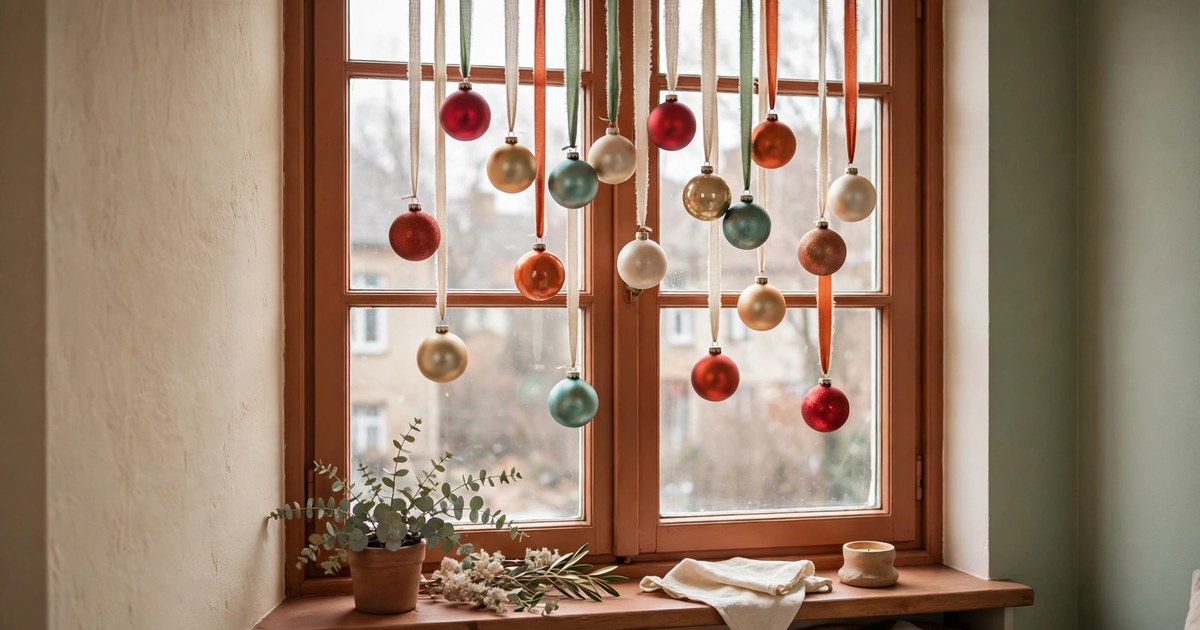
Suction hooks turn the glass itself into a hanging display. A small clear suction hook sticks to a clean window pane, holds a bauble on a length of ribbon or thread, and peels off in January without a trace. Hang three or five baubles at different heights across one window — a mix of sizes, in one colour family so the display looks deliberate — and you have a floating ornament display that catches the light all day and glows when the fairy lights come on at night.
The practical details matter here. Clean the glass first and press the suction cup firmly for a full thirty seconds; a suction hook on dusty glass will slide down overnight and drop your bauble on the sill. Use lightweight shatterproof baubles rather than glass ones — a dropped plastic bauble bounces, a dropped glass bauble does not, and the weight difference also helps the suction hold. Tie each bauble to a different length of ribbon so they hang at staggered heights, and keep the longest drop short enough that the bauble clears the sill. A set of suction hooks costs around $4–6, and a bag of shatterproof baubles starts at about $5.
This is also the best idea on the list for a window above a radiator or a kitchen sink, where there is no sill to decorate at all. The display lives entirely on the glass, so it needs no surface, no shelf and no floor space — a real advantage in a small flat. Take the baubles down by lifting the suction tab, never by pulling the hook, and the glass is left clean. Store the hooks with their suction cups facing up and they will grip just as well next year.
7. Removable frost-effect spray with stencils
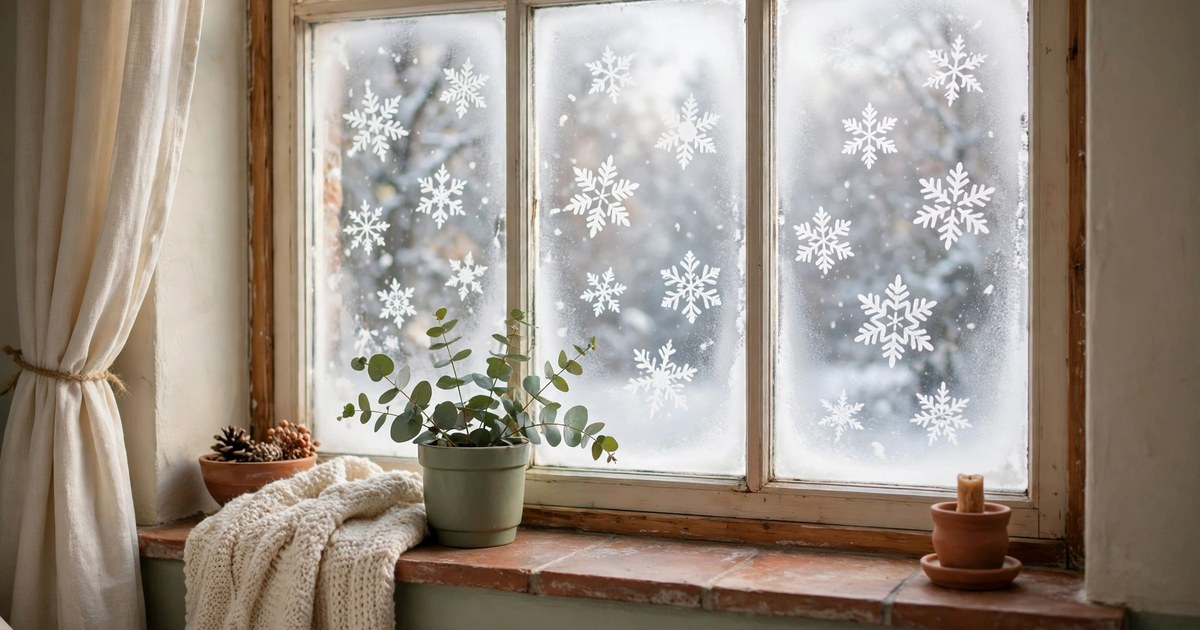
Frost-effect spray is the most dramatic transformation on this list, and it is fully removable. The spray is a white, snow-like coating sold in a can for around $6–9; you spray it onto the glass, it dries to a frosty finish, and in January it wipes off with warm water and a cloth. Used with a stencil — a snowflake, a star, a simple tree shape — it gives you crisp white shapes on a frosted pane that look genuinely wintry from both sides of the glass.
The technique is simple but worth doing properly. Tape your stencil to the inside of the glass with painter's tape, hold the can 20–30 centimetres away, and spray in short, light passes rather than one heavy blast — two thin coats look like frost, one thick coat looks like white paint. For a softer effect, skip the stencil and spray just the corners and edges of the pane, fading toward the middle, so the window looks as though frost has crept in from the cold. Always spray on the inside of the glass, never the outside, so rain cannot wash it away, and open a window for ventilation while you work.
Test the spray on a small corner of one pane first, and check the label says removable — most window frost sprays are, but a craft spray meant for permanent use is not the same product. Removal is a five-minute job with a damp cloth and a little washing-up liquid, and a final wipe with glass cleaner leaves the pane spotless. If you are nervous about spraying, the stencil shapes alone, cut from paper and taped to the glass, give you most of the look with none of the commitment.
8. Silhouette cutouts backlit at night
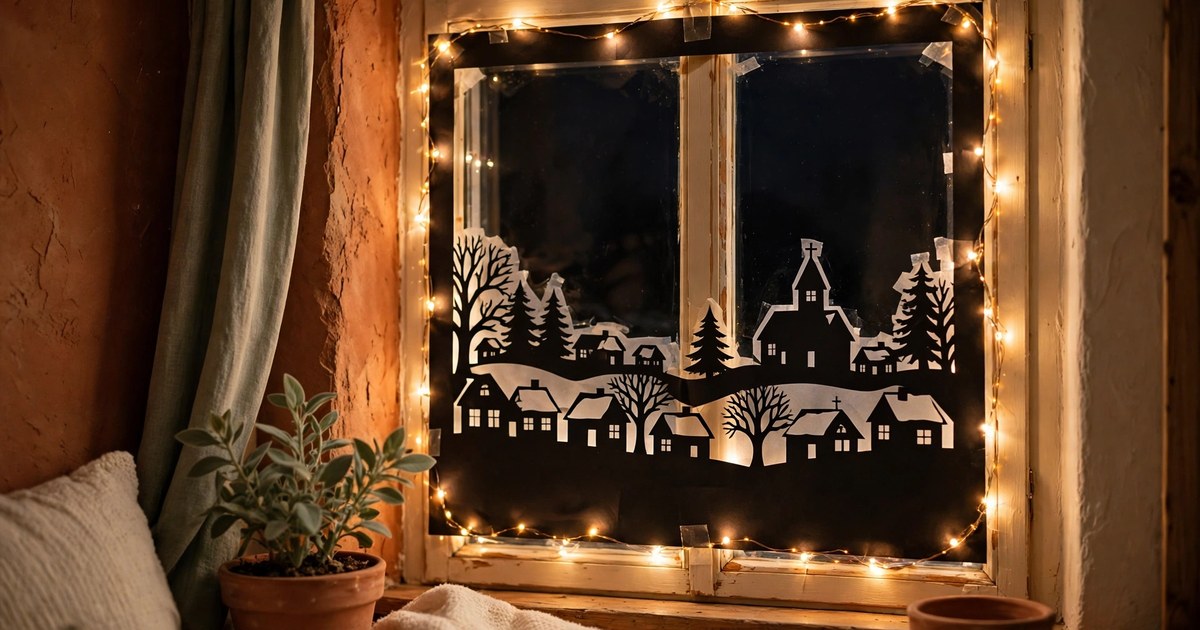
A silhouette cutout is a scene cut from black card — a row of rooftops, a reindeer, a church spire, a line of pine trees — taped to the inside of the glass and lit from behind. By day it is a simple black shape against the daylight; after dark, with a string of fairy lights or a battery candle behind it, it becomes a glowing winter scene that the whole street can see. It is the most theatrical idea on this list, and it costs about $3 in black card.
Cutting a silhouette takes patience rather than skill. Draw or print a simple skyline, trace it onto black card, and cut it out with a craft knife on a cutting mat — long straight cuts for rooftops, simple curves for trees. Tape the finished piece to the inside of the glass with small loops of washi tape, low on the pane so it sits like a skyline on a horizon, and place your light source on the sill behind it. The light should sit between the silhouette and the room, so the card blocks the light and the glow spills around its edges and through any cut-out windows you have made in the rooftops.
The effect is genuinely striking for the effort involved, and it is completely renter-safe: tape on glass, card on tape, nothing touching the frame. Make the silhouette in two or three pieces if your window is wide, and keep the design simple — bold shapes read better from the street than fiddly detail. In January the tape peels off, the card folds flat into a drawer, and the same skyline is ready to go up again next year.
9. Mini wreath on the window with a suction hook
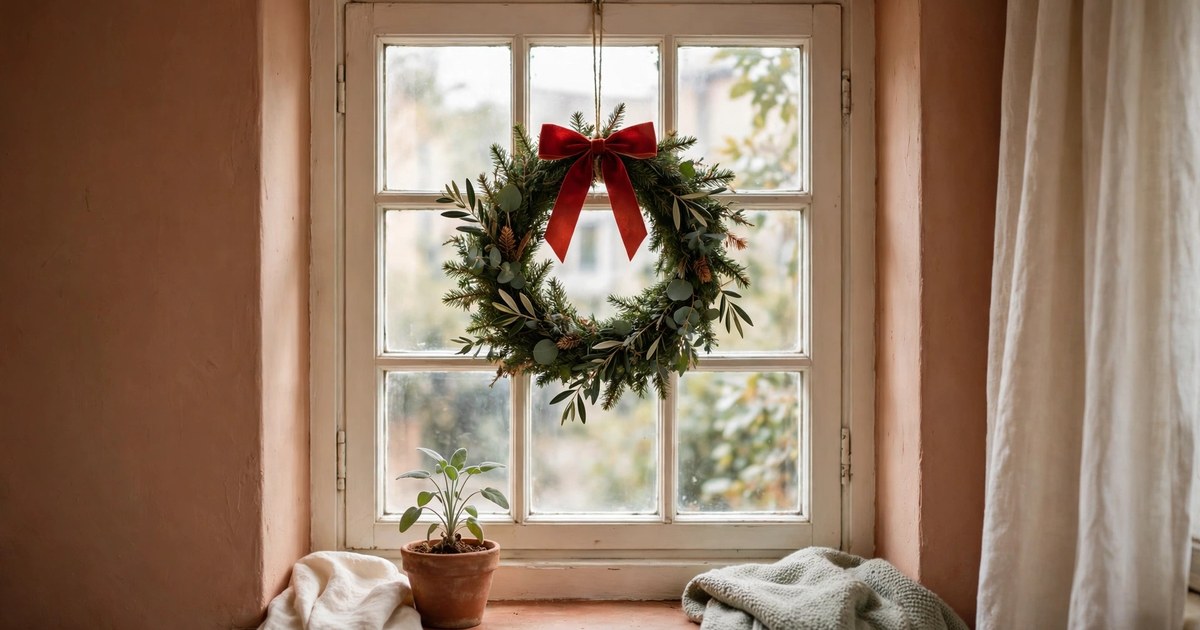
A mini wreath on the window is the smallest, sweetest version of the classic front-door wreath, and a suction hook makes it a renter's decoration. A wreath 20–30 centimetres across — small enough to hang in the middle of a pane without blocking the light — hooks onto a suction cup on the glass, or onto a Command hook on the frame if you prefer the wreath to sit against the frame rather than the pane. A ready-made mini wreath costs around $8–15, or you can make one from a wire ring, faux greenery and ribbon for about half that.
Keep it light: a slim wreath of faux eucalyptus or pine with a single bow weighs very little and a standard suction hook holds it easily, while a heavy wreath loaded with pine cones and baubles needs a hook rated for its weight. Hang the wreath in the centre of the pane for a classic look, or offset it to one side if the window already has lights around the frame. A red or gold ribbon bow at the top ties the wreath to the rest of your scheme, and a few tiny battery fairy lights woven through the greenery make it glow after dark.
The wreath also works as the one decoration for a window you otherwise leave bare — a single wreath in a bedroom or kitchen window reads as intentional rather than unfinished, which is useful when you have five windows and only the energy to dress two of them properly. Check the suction hook's grip once a week through December, especially on a window that gets condensation, and take the wreath down by lifting the suction tab. The hook, the wreath and the ribbon all store flat for next year.
10. Advent-style window countdown with numbered pouches
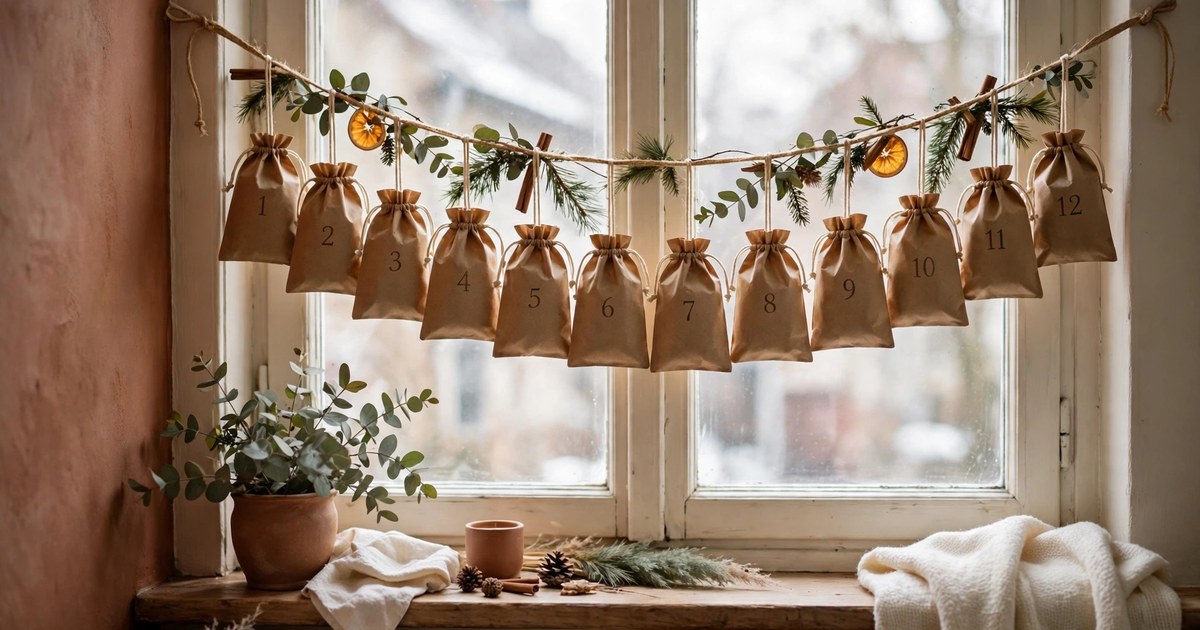
An advent countdown on the window turns the decoration into a daily ritual. Hang a row of small numbered pouches — fabric, paper or kraft envelopes — across the window on a length of ribbon or a tension rod, each pouch holding a tiny treat, a note or a small festive task. Every morning in December, open the next pouch. It is part decoration, part calendar, and in a small flat it replaces a separate advent calendar that would otherwise take up shelf space.
Make the pouches from kraft envelopes or small drawstring bags, number them 1 to 24 with a marker or printed stickers, and peg or clip them along a ribbon strung across the top of the window on Command hooks. Keep the pouches light — a chocolate, a tea bag, a handwritten note — so the ribbon never sags. If twenty-four pouches feels like too many for one window, do twelve for the twelve days of Christmas, or seven for the final week. A set of small kraft pouches costs around $5–8, and the ribbon and pegs are pennies if you already have them.
The countdown works best on a window you see every morning, like the kitchen window, where opening the day's pouch becomes part of the routine. Let children pick the treat inside, or fill the pouches with small acts of kindness — a compliment, a favour, a shared walk — and the window becomes the family's December centrepiece rather than just a decoration. When Christmas Day arrives, the empty pouches come down with the ribbon, fold flat into an envelope, and wait for next year, leaving nothing behind but a clean window.
Shop this look: Christmas window decor
- Battery fairy lights, 3 m, 40 LEDs — warm white with a timer, run around the window frame for the highest-impact decoration on this list. Shop battery fairy lights
- Static-cling snowflake decals — stick with static alone, no glue, and peel off clean in January. Shop static cling snowflake decals
- Tension rod — wedges in the window reveal and holds a garland with no screws or brackets. Shop tension rods
- Battery window candles, pair with timer — the warm glow on the sill, with no flame near curtains. Shop battery window candles
- Clear suction hooks — hang baubles and mini wreaths straight from the glass. Shop suction hooks
- Shatterproof baubles — lightweight, so the suction holds and a drop is no disaster. Shop shatterproof baubles
Frequently Asked Questions
Will Command strips damage my window frames?
No, if you use them correctly. Command strips are designed to remove cleanly from painted surfaces: pull the tab slowly straight down, parallel to the surface, and the adhesive stretches off without taking paint with it. The damage happens when people pull the tab outward or yank the hook off. Use the right weight rating for your lights, and never use Command strips on fresh paint less than a month old, on wallpaper, or on rough or flaking surfaces.
Do suction hooks really stay up all December?
Yes, on clean, smooth glass. The two reasons suction hooks fail are dust on the glass and moisture from condensation. Wipe the pane with glass cleaner before you stick the hook on, press firmly for thirty seconds, and check the grip once a week. On windows that get heavy condensation, a Command hook on the frame is the safer choice for anything heavy, and suction hooks are best kept for lightweight baubles and mini wreaths.
Can I use real candles in my windows?
We would not recommend it in a rented flat. A real flame near curtains, on a narrow sill, in a room you leave unattended, is a risk no landlord wants and no insurance policy favours. Battery LED candles give you the same warm glow, cost around $9–15 a pair, and most have timers that switch them on at dusk. See our Christmas window candles under $25 for the best options.
What is the cheapest way to decorate a rental window for Christmas?
Paper snowflakes cost nothing but an evening and a sheet of paper, and static-cling decals cost around $4–8 for a sheet that lasts several years. If you can stretch to one purchase, a battery string of fairy lights for $6–10 gives you the most impact per pound spent, and it works with the snowflakes or decals you already have.
How do I remove frost spray and decals in January?
Frost spray wipes off with warm water, a little washing-up liquid and a cloth, followed by a final wipe with glass cleaner. Static-cling decals peel off by hand and leave nothing behind — just store them flat on their backing sheet for next year. Command hooks come off by pulling the tab slowly straight down, and suction hooks release by lifting the small tab on the cup. The whole window should be back to normal in under ten minutes.